Which perimeter-wire-free robot mower to choose in 2026? The market has turned
the page on the buried cable: RTK, LiDAR and vision dominate, with setups
in under two hours. Five models plus one out of category, compared on the six
same criteria — published weighting, source of every figure stated. These
robots were not lab-tested by the editorial team: the Method section details
where every figure comes from.
By the editorial teamPublished 12 March 2026Reviewed 31 July 2026Read time ~9 min
Affiliate links. As an Amazon Associate, this site earns a
commission on qualifying purchases. This doesn't change the price you pay, nor
the order of the ranking — the scoring grid is published
in the Method section.
Overview
The rankings, sorted by score
Editorial score out of 10, calculated with the weighting published below.
Prices are pulled live from Amazon.co.uk.
C Manufacturer data (public spec sheet) ·
A Synthesis of public reviews ·
E Editors' estimate
Before you compare
The six criteria that really decide
01Navigation: RTK, LiDAR or vision
RTK locates itself by satellite with centimetre accuracy — but requires a
clear sky. Dense trees, walls, eaves disturb the signal. LiDAR
maps with a laser without depending on GPS; vision recognises the boundary between
lawn and driveway. Look at your garden before you look at the spec sheets: it's the
garden that picks the technology.
02The real area, not the claimed one
The manufacturer's capacity assumes a flat, open, single-piece
lawn. Slopes, narrow passages and separate zones quickly reduce it: plan
a 20 to 30% margin over your actual lawn.
03Slopes and drive wheels
Beyond about 35% slope, a two-wheel-drive model spins its wheels on wet
grass. AWD models climb far more — up to 75% claimed on some
4×4s — but cost more. Measure your steepest slope before choosing, not
after delivery.
04The edges
It's the difference between 'I don't mow anymore' and 'I finish with the edge
trimmer every week'. Blade offset, blade close to the edge or integrated edge trimmer:
check how the robot handles the last ten centimetres along walls and
flower beds.
05Safety, for you and wildlife
Lift and obstacle sensors are standard. Less well known: hedgehogs
freeze when faced with danger instead of fleeing. Schedule mowing during the day — nocturnal
wildlife will thank you, and the vision of camera-equipped robots works better.
06The cost of ownership
Blades to replace several times a season, an ageing battery, a possible
4G subscription for the anti-theft system, frost-free winter storage. Over five years, the gap between a
model with generic parts and a locked-down one can pay for the next
robot.
The fact sheets
What each robot does well, and what it doesn't
01
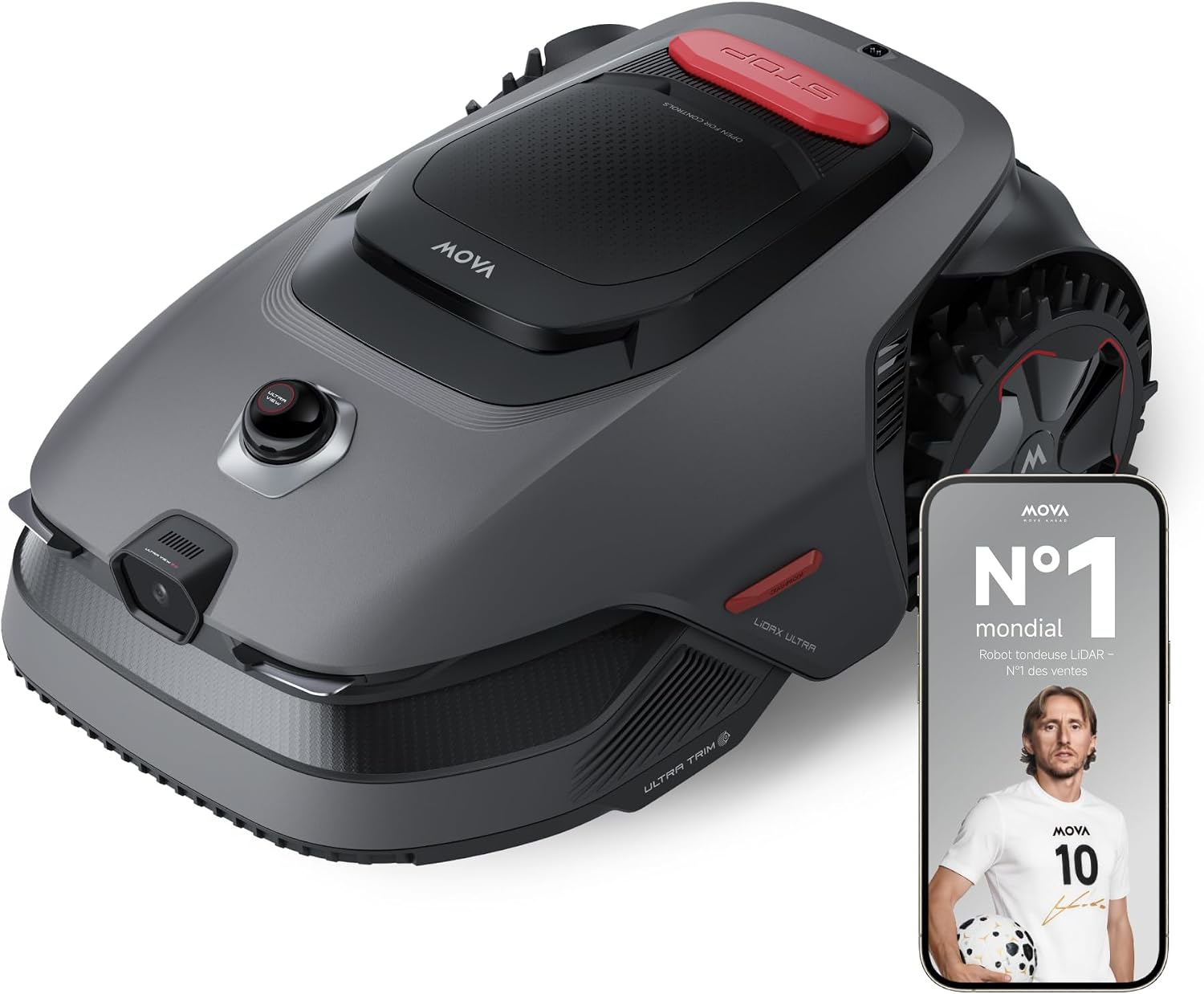
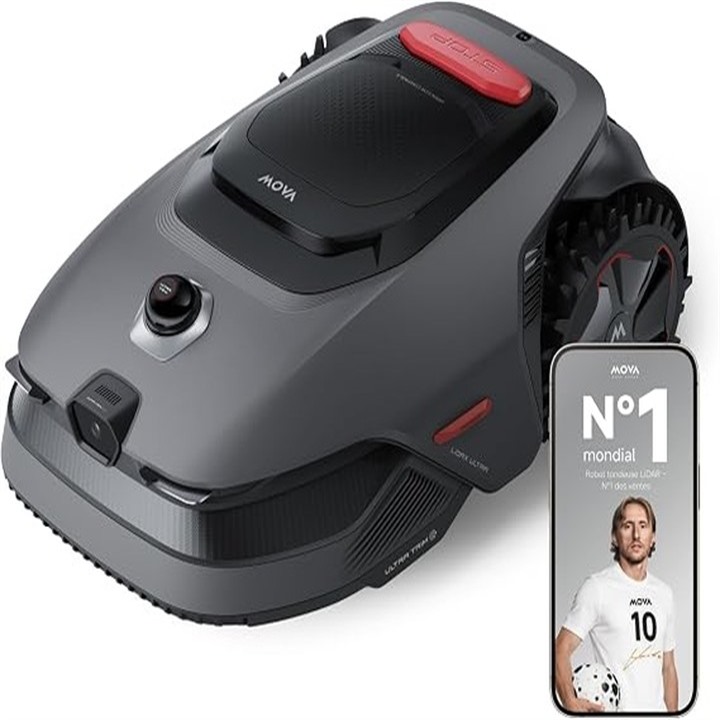
Mova LiDAX Ultra 800
Best for most gardens
3D LiDAR and vision combined, no RTK antenna and no boundary wire, and a cut claimed within 5 cm of edges. It's the best compromise in the selection for a standard-size garden.
Navigation C
3D 360° LiDAR + AI vision, no cable and no RTK station
Area C
800 m² (manufacturer designation)
Edges C
UltraTrim 1.0, cuts within 5 cm of walls and hedges
Avoidance C
More than 300 obstacle types recognised
Price on Amazon.co.ukAutomatically pulled via the Amazon API — the price shown on Amazon.co.uk at the time of purchase prevails.
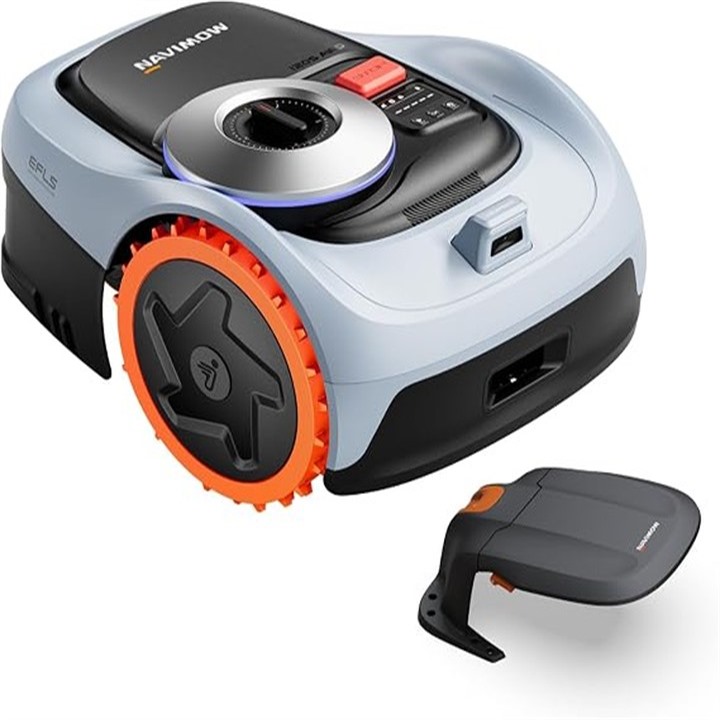
Three drive wheels and automotive-grade stability control: it goes where a two-wheel-drive spins. The best entry point in the selection for rough terrain, within the claimed 500 m² limit.
Navigation C
EFLS + triple-frequency NRTK network + vision
Area C
500 m²
Drive C
Three drive wheels (AWD), electronic stability control
Maximum slope C
45% (24°)
Price on Amazon.co.ukAutomatically pulled via the Amazon API — the price shown on Amazon.co.uk at the time of purchase prevails.
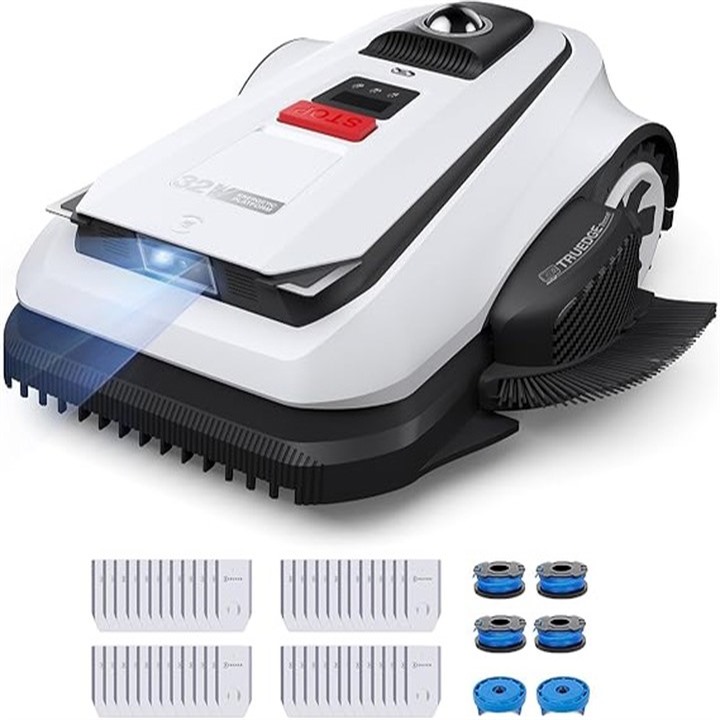
1,600 m² claimed with a dual LiDAR independent of satellite, a rotating-filament edge trimmer and the best slope capability on the page. It's also the most expensive.
Navigation C
Dual-LiDAR + AI vision, holographic map, 2 cm accuracy
Area C
1,600 m²
Setup C
15 minutes, no RTK reference station
Edges C
TruEdge edge trimmer with flexible rotating filaments
Price on Amazon.co.ukAutomatically pulled via the Amazon API — the price shown on Amazon.co.uk at the time of purchase prevails.
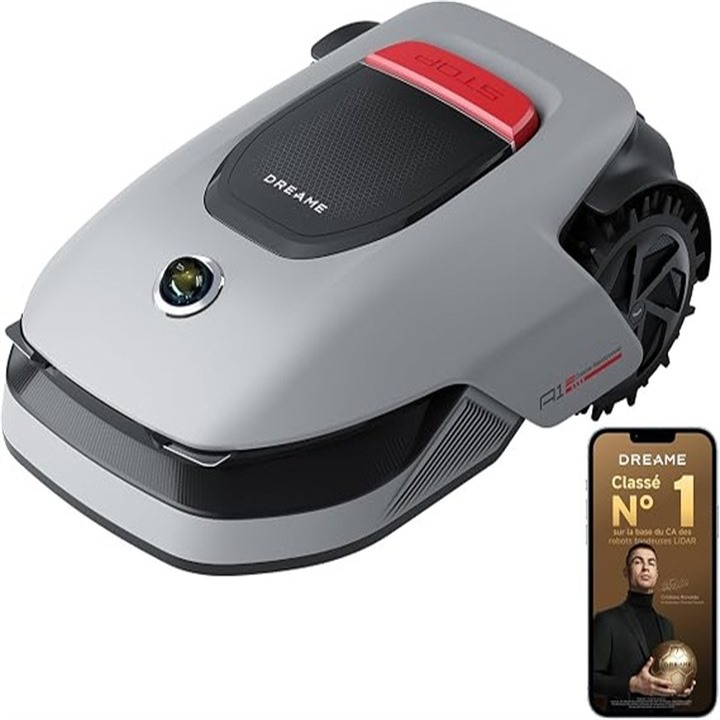
Mapping without cable or RTK beacon, 360° 3D avoidance and a claimed capacity of 2,000 m² in 24 hours. It's the model that needs the least adjusting to cover a large area.
Navigation C
OmniSense, mapping without cable or RTK beacon
Avoidance C
360° 3D point cloud
Area C
Up to 2,000 m² maintained in 24 h
Path C
U-shaped, even coverage
Price on Amazon.co.ukAutomatically pulled via the Amazon API — the price shown on Amazon.co.uk at the time of purchase prevails.
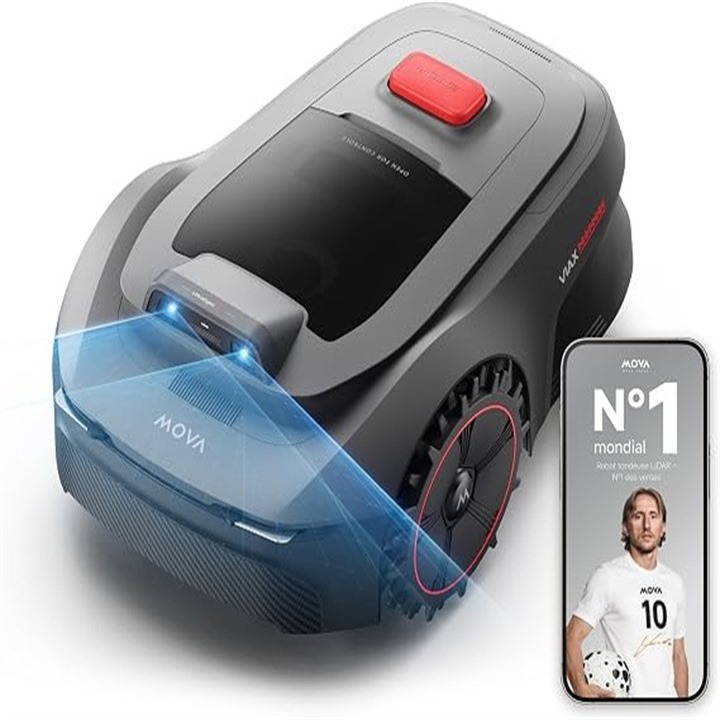
The entry ticket of the ranking, and it's better equipped than you'd expect at this price: HDR dual vision, U-shaped path, double edge cutting and anti-theft. Without LiDAR or RTK.
Navigation C
UltraEyes 1.0, dual vision with HDR imaging
Field of view C
120° × 70°, 50 m range
Recommended area C
250 m²
Installation C
Wire-free, no RTK station or signal posts
Price on Amazon.co.ukAutomatically pulled via the Amazon API — the price shown on Amazon.co.uk at the time of purchase prevails.
2,000 m² claimed, expandable up to 2,400, two 320 mm cutting decks and an 88 W motor. Out of category because it plays in a different league, in size and budget.
Area C
2,000 m², expandable up to 2,400 m²
Navigation C
NetRTK + vision, Ultra Sense AI automatic mapping
RTK antenna C
Included as standard; NetRTK option without installation
Avoidance C
3D stereo vision, objects detected from 2.5 cm
Price on Amazon.co.ukAutomatically pulled via the Amazon API — the price shown on Amazon.co.uk at the time of purchase prevails.
These robots were not lab-tested by the editorial team, and saying so is
more useful than claiming otherwise. The ranking rests on three sources,
identified by a marker next to every figure:
C public manufacturer spec sheets;
A a synthesis of public reviews and after-sales feedback, kept
only when the same point comes up massively;
E an editors' estimate, to be treated as an order
of magnitude. Prices come from the Amazon API and are refreshed
automatically, with the date of the latest pull shown under each card.
Scoring weighting out of 10
Criterion
What it measures
Weight
Mowing quality
Evenness, height, finish
25%
Navigation
Coverage, obstacles, missed zones
20%
Reliability
Breakdowns, after-sales returns, spare parts
20%
Setup and app
First run, mapping, settings
15%
Slopes and edges
Difficult terrain, finishes
10%
Cost of ownership
Blades, battery, subscriptions over 5 years
10%
Frequently asked questions
Before you order
What's the best robot mower in 2026?
For most standard-size gardens, the Mova LiDAX Ultra 800: 3D LiDAR and vision combined, no antenna to install, and a cut claimed within 5 cm of edges. On rough terrain and up to 500 m², the Segway Navimow i205 AWD and its three drive wheels are the best entry point. For a large tree-filled garden, the Ecovacs GOAT A1600's dual LiDAR doesn't depend on any satellite signal.
RTK, LiDAR or vision: which should you choose?
Look at your garden. Clear sky and open lawn: RTK offers the
best accuracy. Dense trees, walls, covered passages: LiDAR maps
without satellite. Vision complements either for obstacles. The
best 2026 models combine two of these.
What mowing area should you plan for?
Plan a 20 to 30% margin over the claimed capacity: it
assumes a flat, open, single-piece lawn. Slopes, narrow passages
and multiple zones reduce the real coverage.
How do you winterize a robot mower?
At the end of the season: charge the battery, clean the robot and its chassis, then
store it in a dry, frost-free room. The station only stays outside if the
manufacturer says so. In spring, check the blades and update
the app before restarting.
If you're still hesitating, take the Mova LiDAX Ultra 800: it's the choice least
likely to disappoint on a classic garden. If the terrain is modest
but rough, the Navimow i205 AWD does the essentials for less. And the YUKA 2000
isn't aimed at the same buyer: it's a large-property machine, out of the
ranking for that reason. A word on the selection itself: several models
heavily discussed online — the Yuka Mini 2, the Navimow i105E, the Luba 2 AWD — don't
appear here because they simply aren't sold on Amazon.co.uk. Ranking
them would have made a nice comparison, but not a buying guide.